
Nathan Abels, "Desert Sage", Acrylic on Linen, 24x36"
Scroll down to see the process of how this developed.
Scroll down to see the process of how this developed.


 Caspar David Friedrich, "Evening Landscape with Two Men", 1830
 Rebecca Wallace, Sun glare, Oil on Panel 12 x 16", 2009
 Rebecca Wallace, The space that was created to fill the gap that was left when it disappeared. Oil on Panel 18 x 20", 2010
 Rebecca Wallace, Attempt # 1, Oil on canvas 21x28", 2009
 Rebecca Wallace, Bon voyage. 22 x 30" charcoal on paper. 2010
 Rebecca Wallace, Vol 30. No. 9., Graphite and watercolor on paper, 8 x 8", 2010
 Rebecca Wallace, At this time you must always have games. Graphite and color pencil on paper, 23 x 29", 2010
 (Untitled), Acrylic on Paper, 5x7"
 (Untitled), Acrylic on Paper, 5x7"
 Jean-François Millet, Nuit Étoilée (Starry Night), c. 1851. Oil on canvas, 65.4 x 81.3 cm. Yale University Art Gallery - via Art History tumblr
 Rebeca Mendez, Weatherscape #03, 2008. Archival Inkjet Print on Epson Ultra Smooth Fine Art Paper. 30×40 inches. ed. 7
 Weatherscape #01, 2008. Archival Inkjet Print on Epson Ultra Smooth Fine Art Paper. 30×40 inches. ed. 7
 Weatherscape #14, 2008. Archival Inkjet Print on Epson Ultra Smooth Fine Art Paper. 30×40 inches. ed. 7
 Albert Pinkham Ryder, The Sheepfold, Oil on Canvas, 1870
"If Bierstadt's and Moran's vistas trupeting national opportunity represent one extreme- landscape as expansive, public declaration- Ryder's small nature notes seem to have imploded, leaving a small, silent, concentrated core."
~From Albert Pinkham Ryder by Elizabeth Broun


"...anyone who gazes at Ruysdael's river under a cool sky [pictured above] will soon notice what is strange about it. The soft pale green trees that fringe the river are reflected in its calm glassy surface so completely and clearly that the painting depicts two worlds, not one: the mirror-world in the water conjoins with its counter-image above, the roots of the trees literally pointing in two directions. What at first seemed a simple scene turns out to hint at a portal to another dimension, a grotesque intertwining of worlds. There is as much suggestion, as much mystery in this painting as in any surrealist dreamscape."I agree - and on a more personal note I find the mysterious qualities of Dutch landscapes to be much more intriguing than most surrealist works. Probably no suprise.


 overlooking South Park valley
 I love the abstract quality of this image.
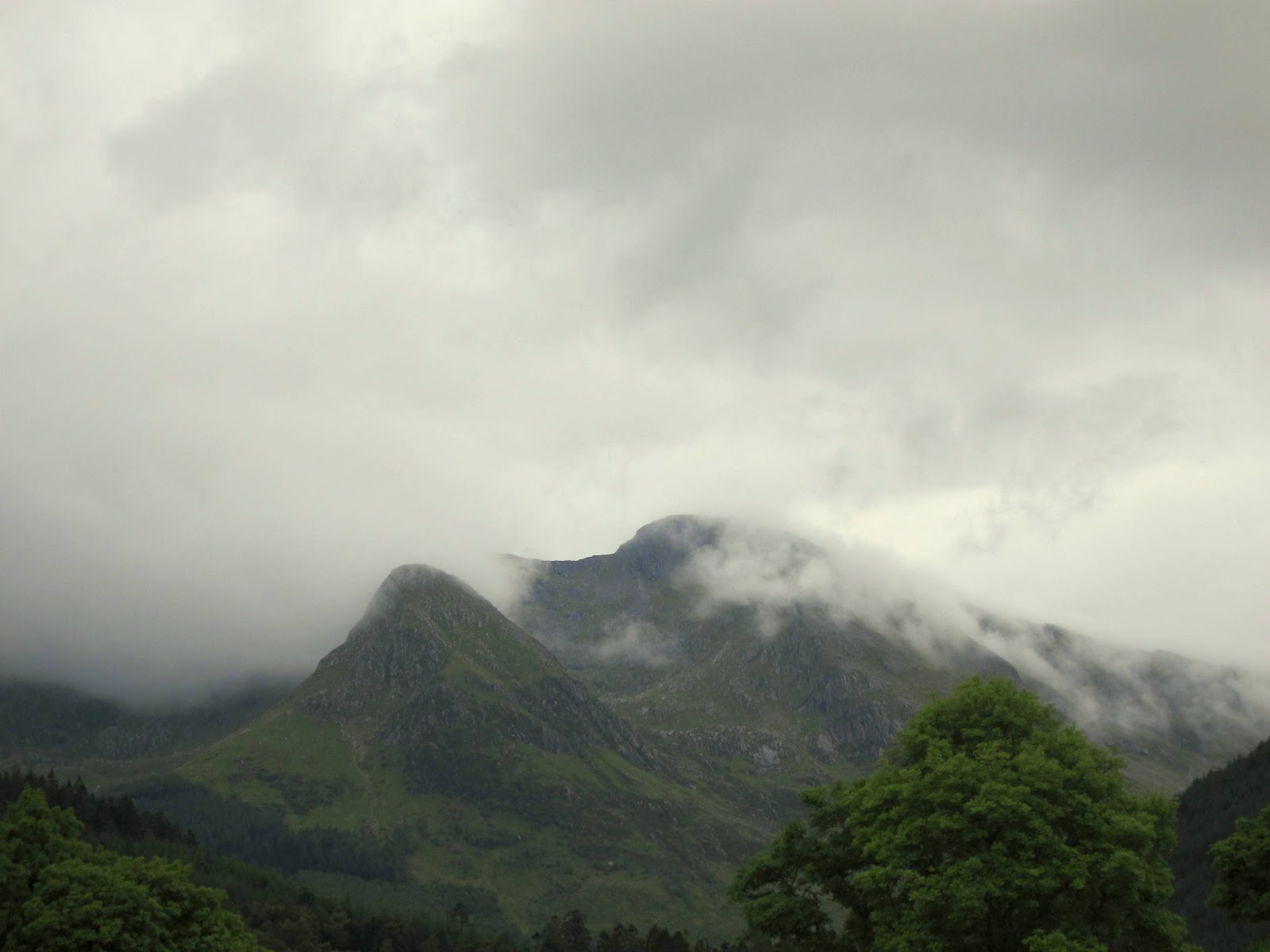
 photo taken in Rocky Mountain National Park this last weekend.
Sir Francis Head says that in America “the moon looks larger” than in Europe. Here, then, more moonshine is to be expected. Perhaps the sun looks larger also. Such are the advantages of the New World. The same writer says, “the heavens of America appear infinitely higher,” “the stars are brighter.” These, too, are encouraging facts, symbolical of the height to which the philosophy and poetry and religion of her inhabitants may one day soar. At length, perchance, the immaterial heaven will appear as much higher to the American mind, and the intimations that star it will appear as much brighter. For I believe that climate does thus react on man, and that there is something in the mountain air that feeds the spirit and inspires. We shall be more imaginative; we shall be clearer, as our sky, bluer, fresher; broader and more comprehensive in our understanding, like our plains; our intellect on a grander scale, like our thunder and lightning, our rivers and our lakes, and mountains and forests. Are not these advantages? Will not man grow to greater perfection intellectually as well as physically under these influences? Or is it unimportant how many foggy days there are in his life?
 J.E.H. MacDonald, In the Pine Shadows, Moonlight, 1912, oil on canvas 81.9 x 70.9 cm
 J.E.H. MacDonald, Moonlight Harvest, 1913, oil on canvas 41 x 51 cm
 Peter Doig
 Peter Doig


