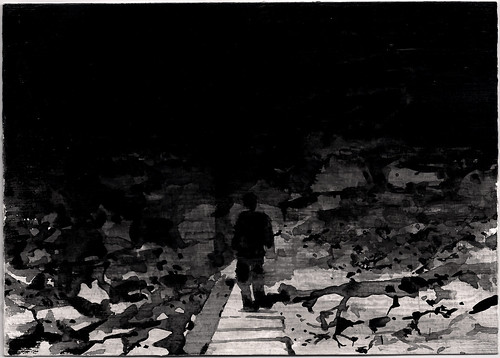
The Guardian's Johnathan Jones wrote an article today called "
Why the Best Art is Meaningless." In it he elaborates on his belief that once the concept or meaning of a work of art is made clear then, "what is left to say?" To Jones, "beauty is better than a big idea," going on to say, "Real art doesn't have a message, doesn't necessarily say anything."
It is interesting to read the comments on this post as well - poster BestoftheBest writes, "it's possibly the abstraction of a meaning or intention and the involvement this beckons, rather than the bleeding obvious, that nourishes. The veneer of meaningless is a bluff. But if there's nothing there, it evaporates pretty quickly." Another comment by shakinwilly reads, "Not meaningless but ambiguity is a characteristic of great art."
In undergrad I was frequently asked what are my "concepts" and even in grad school it was a very concept-driven program - I'm not saying these are bad things but the freedom of making art that doesn't have to push an idea is very appealing to me as an artist.
I have been having this constant quarrel in my mind about my next show - whether I should have a more defined concept or not. The statement I wrote for the upcoming issue of New American Paintings reads, "These images are a response to natural processes and the noticeably unnatural human habitat. They depict the effects of construction and destruction – each image functioning as a visual pause; a contrast in this persistent turbulence." I stress the visual image in this statement - perhaps more than a clear concept.
I personally agree with the sentiments of Jones and as it stands right now, my next show will be "about" ambiguity - with what Jones calls, "real art's difficulties."
A post at
Learning to Stay blog called, "
Why We Need Art" goes on to stress more than our desire for mystery but our
need;
- "We now know enough to know that we will never know everything. This is why we need art: it teaches us to live with mystery. Only the artist can explore the ineffable without offering us an answer, for sometimes there is no answer. John Keats called this romantic impulse 'negative capability.' He said that certain poets, like Shakespeare, had 'the ability to remain in uncertainties, mysteries, doubts, without any irritable reaching after facts and reason.' Keats realized that just because something can't be solved, or reduced into the laws of physics, doesn't mean it isn't real. When we venture beyond the edge of our knowledge, all we have is art."
~
Jonah Lehrer, from
Proust Was a Neuroscientist
 Robert Polidori, Versailles, Salle de L’Afrique, Portrait Achille Bazaine 1867, 2007, colour photograph
 Florian Maier-Aichen, Untitled, 2005, c-print, 62.2 x 73.7 cm


 City Park, Denver - photo by Lorna Cochrane
 John Baldesarri, "Tips for Artists Who Want to Sell"
 I'm going to give blood this morning - which reminds me - the Barnaby Furnas show at the MCA Denver has some monumental blood-red abstracts up right now.
 (I don't love the logos on the back, but it is better plywood)
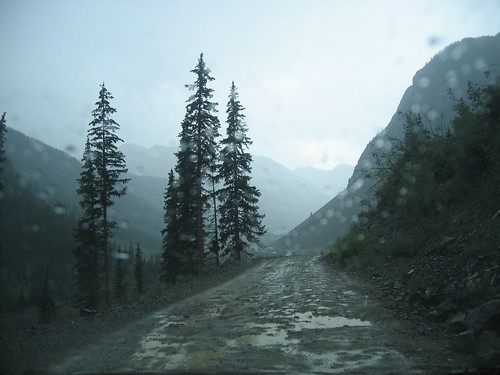 Here is the reference image I used for a work I did last year- I painted this pretty directly (including most of the tree branches and far off mountains) before adding a layer of semi-transparent blue/white over it for the final painting:
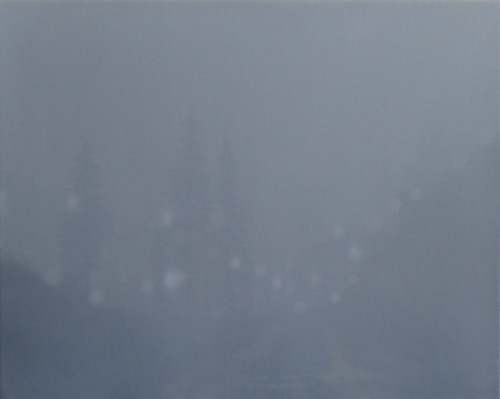 Here are the references for my next work:
 Above is the image that I will be portraying in the painting and below is the day-light image that I took yesterday to have a better idea of what I'm painting: