Showing posts with label aspen. Show all posts

Monday, September 27, 2010

Weekend

We spent another weekend in the Leadville area and half our group conquered Mt. Elbert - Colorado's highest peak (the rest retired early). Here's a photo taken by Lorna of the crowd at the top.

It was a perfect day for a long hike and we also caught the last of the golden aspen leaves:

and a beautiful evening next to Twin Lakes:

Sunday, September 19, 2010

Your Moment of Apsen Leaves


took this next to the Twin Lakes near Leadville on Saturday

Monday, September 13, 2010

Wooes

(photo from last year - the Aspens are nearly in season this year already)


And the wind, full of wantonness,
wooes like lover
The young aspen-trees till they
tremble all over.

- Thomas Moore (From Trees of America) via Design Squish blog

Sunday, September 20, 2009

Fall All Leaves All Fall


This is my favorite time of year. We took a short day trip to Estes Park and Rocky Mountain National Park yesterday to enjoy the beautiful, eerie sounds of elk bugles and the yellow aspen leaves.
Drive-by out-the-window photo by Lorna Cochraneriver reflection photo by Nathan Abels - after Alexander Binder

Saturday, May 30, 2009

Photo of the Day: The Maroon Bells


I took this photo of the Maroon Bells yesterday while flying over Aspen for a photo job. You can see the reflection of our airplane window at the top.

Tuesday, December 23, 2008

Wednesday, October 1, 2008

Fall

photo by Nathan Abels

A couple of weeks ago I flew over the mountains and I could see some small pockets of aspen trees changing colors (see this post) - well just yesterday I flew over the foothills by Boulder and you could see the yellow leaves of the aspens are in full effect.

I was debating whether I've been posting too much lately about trees and nature and not enough about art, but it is fall and it's my favorite time of year to be outside. So I suppose I would be posting more about these subjects. That and all the stuff I've been working on is in-process.

Wednesday, September 17, 2008

Signs of Fall

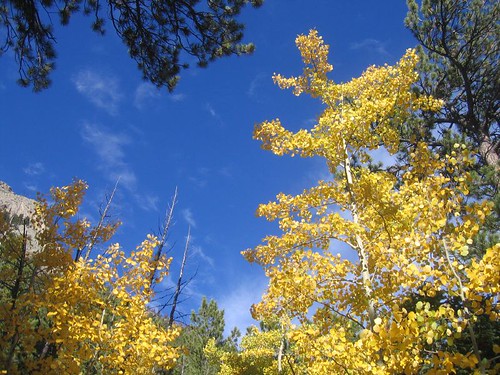
Flying through the mountains yesterday gave me my first glimpse of the best part of Fall here in Colorado: the aspen trees. Just look at how those aspens glow yellow around all the pines. I can't wait to get back up to Rocky Mountain National Park and listen to the elks bugling (watch this youtube clip) and admire the vibrant yellow leaves:


Here's another great snap I took yesterday that would look great as your new desktop background.All photos by Nathan Abels

Tuesday, February 19, 2008

Carved Aspen Tree Art and History

The next time you may be hiking out west through an aspen grove - take a closer look at the carvings and writing on their surfaces. There is a rapidly disappearing history of migrating sheepherders carved into them.

According to the National Parks Service website,

"[Carved] Aspen trees ... bear the marks of those who came before. Known as arborglyphs, dendroglyphs, or aspen art, the carvings provide an important record of the area's history.

The practice was started by Basque sheepherders in the late 1800s. Basque sheepherders were replaced by Peruvian sheepherders in the late 1900s adding yet another style and mix of arborglyphs. Recreational campers and cattlemen also left their marks, some of which date from the early 1900s.

The Basques, who call themselves Euskaldunak, are from the Pyrenees Mountains located on the border of Spain and France. Basques have their own language known as Eusk but since the majority live in Spain, they also speak, read and write in Spanish. This explains why some of the carvings contain a mix of both Eusk and Spanish."

The Hispanic roots of Colorado and New Mexico carved Aspen trees is explained by Arborlyphs.com writer, "Particularly intriguing about the carvings of Colorado and New Mexico is that they were not carved by Basque shepherds, but by Hispanics, whose forefathers had been in the area for generations. Among these herders were descendants of early pioneer families, settlers that came north from Mexico when this part of country was known as Nuevo Mexico and controlled by Spain. There was some Basque immigration to the Grand Junction, Colorado area but little if any to the south San Juans. These carvings are culturally different from the Basque carvings making them even more significant to Colorado and New Mexico’s history."

LinkWithin

Related Posts with Thumbnails