 (historic photo via Elitch Gardens Historic Theatre website)
 Color photos by me.


 (historic photo via Elitch Gardens Historic Theatre website)Color photos by me.
 I'll walk you through the trial one photo at a time - starting here along the Main St. in Silver Plume. At the end of the street you'll see a white building that says "Bakery" - the Sopp & Trusket. I'd highly recommend getting some baked goods there before or after your hike. Any time I'm near Silver Plume I pick up a loaf of bread there. At one of the few stop signs in town you'll see this green garage across the street from a antique store. Take the road up the hill towards the trailhead.
 This way:
 At the top of the hill you'll see this sign for the 7:30 Mine Road -named after the mine that Clifford Griffin worked at in the 1800s. Follow the road to the right (east) -uphill.
 Here's a photo of the trail at that point:
 Not far up the hill there is a split -one trail cuts back to the left towards town and the other continues uphill. Keep going straight ahead (uphill).
 Here's the view of Silver Plume and I-70 at this point in the hike:
 Farther along you'll see a couple of telephone poles and some mining remnants -you'll follow the trail up and to the right (away from the poles):
 A cairn along the way:
 Another cairn:
 You will then come upon a large gulch of avalance debris - you will walk through the fallen trees uphill towards the trail entering a more wooded area. This is a photo taken in the middle of the gulch -looking downhill.
 The trail at this point was a little snowy but in the summer there is a nice stream wandering along the trail. It can get a little muddy here:
 You'll cross over these mining cables a couple times as you zig-zag up the mountain:
 This is a good spot to stop for a food or water break (watch out for nails on the ground):
 More mining debris along the trail:
 Another shot of the mining cables crossing the trial farther up:
 The trial gets rockier here and pretty narrow in parts:
 You'll pass this cave/mine shaft/hole. I've dared myself and friends to go into it, but we're all too chicken.
 There are a few grated mine shafts at this point:
 Another cairn:
 When you see this grate you will take the trail to the left - to the out-cropping where the memorial resides:
 It can be a little hard to see for a minute, but as you go down the trail (not far) you can't miss the large granite monument:
 The Clifford Griffin memorial above Silver Plume, Colorado:


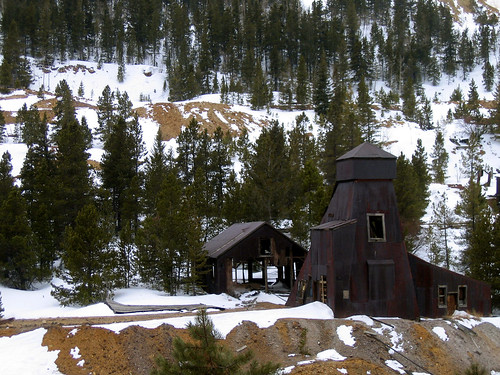 Nathan Abels, "Nevadaville Mining Ruins"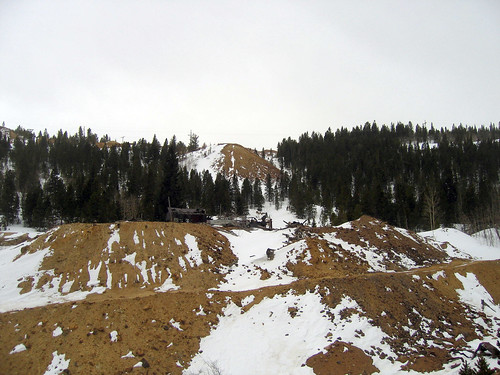
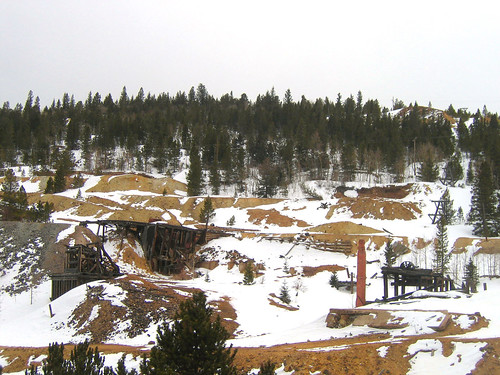


Numerous empty structures litter the surrounding hills and large deposits of the gold-gray colored dirt from mining fill the valley. It was a strange place, and since moving to Colorado this was the fullest ghost-town we've encountered in terms of standing structures. I find these time-capsules in the mountains to be quite fascinating and I'd recommend taking the Peak to Peak byway to anyone along the Front Range. It's an easy day trip with lots to see. More of my pics from the trip can be found here.
 via Fultxo's flickr set of Basque Tree Carvings
 via Fultxo's flickr set of Basque Tree Carvings
 via ccguidedogs@sbcglobal.net's flickr set
 via Snakeriverphotography


